Local Growth Insights
Actionable tactics on local search algorithms, proximity grids, Google Maps dominance, and high-converting acquisition.
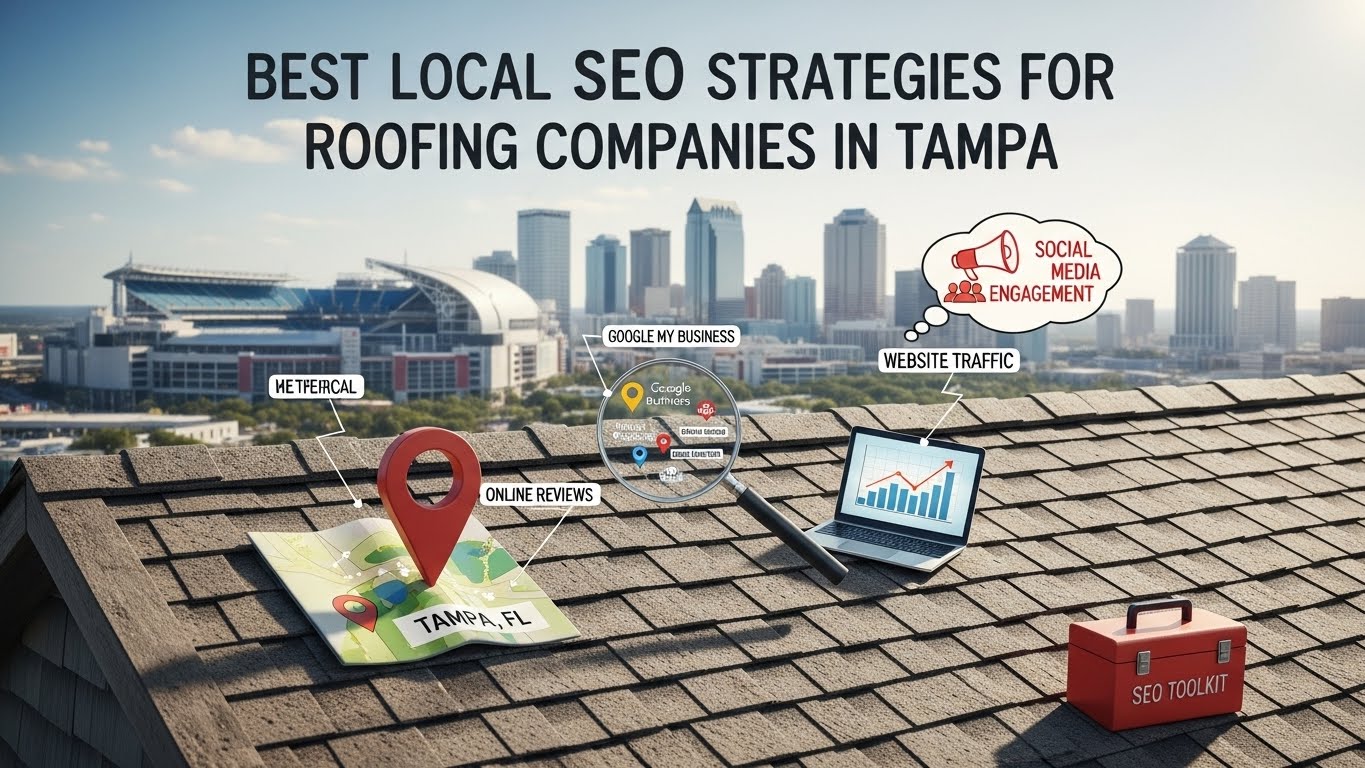
Best local SEO strategies for roofing companies in Tampa
If your Tampa roofing company isn’t showing in the Google Map Pack, your competitors are getting the calls, even if your work is better and your prices are fairer.Local SEO for roofers isn’t about "blogging more" or chasing junk backlinks from overseas. It’s about sending Google the right local trust signals so your business shows up exactly when a homeowner in South Tampa or Brandon searches “roof repair Tampa” or “roofing company near me.”Below are the local SEO strategies that actually move the needle for roofing companies in Tampa.Why Local SEO Matters More Than Organic Rankings for Tampa RoofersMost high-intent roofing searches in Tampa trigger the Google Local Pack. That’s the map section that sits above the organic links, featuring:Direct "Call" buttonsOne-tap DirectionsSocial Proof (Reviews)Homeowners dealing with active leaks, hurricane damage, or urgent insurance claims don’t scroll past the first three map results. They click, they call, and they book.Ranking #1 organically but #5 in Maps still means you are invisible to the most profitable leads.1. Choose the Correct Google Business Profile CategoriesThis is where most roofers fail before they even start. Your Primary Category is the single most important ranking factor for the Map Pack.Primary Category: Roofing ContractorSecondary Categories: * Roof RepairRoof ReplacementWater Damage Restoration (Only if you actually do it)Gutter Installation Pro Tip: Do not add "General Contractor" unless that is your main bread and butter. It dilutes your authority. Category selection directly affects how high a roofing company ranks in the Tampa Local Pack.2. Optimize Service Areas for Tampa! Not the Whole StateMany roofing companies try to "cast a net" over the entire state of Florida. Google sees this as a lack of focus, and it actually shrinks your visibility.Better Approach: Be the Local AuthorityLimit your service areas in your Google Business Profile to:Tampa, Brandon, Riverview, Carrollwood, and Temple Terrace.Why it works: Proximity is the #1 ranking factor. If Google thinks you are "everywhere," they won't rank you "anywhere" specifically. Support these specific locations with dedicated content on your site.3. Create Tampa-Specific Roofing Service PagesIf your website is just a digital brochure, it's useless for SEO. Your site must serve as the "evidence" that backs up your Google Business Profile.Required Pages for Tampa Roofers:Roof Repair in Tampa (Focus on common local leaks)Tampa Roof Replacement (Focus on permitting and local codes)Storm Damage Restoration Tampa (Focus on insurance claim assistance)Each page should include:References to Tampa’s unique weather (High-UV exposure, afternoon thunderstorms, hurricane season).Hyper-local internal links: Roof Repair in Tampa → /roof-repair-tampa/4. Write a Roofing-Focused Business Description with Tampa ContextYour business description isn't a place for your mission statement. It’s a place for keywords and context.The Formula:Mention who you are, what you do, and exactly where you do it.“We’re a family-owned, licensed Tampa roofing company specializing in shingle and tile roof repairs, full replacements, and hurricane damage restoration across Hillsborough County.”5. Use Roofing Job Photos That Build Local TrustGoogle’s "Vision AI" scans your photos. If you use a stock photo of a house in Ohio with a chimney and snow, Google knows it's not a Tampa home.Upload Real-World Photos:The "Truck Shot": Your branded truck parked in front of a recognizable Tampa street.The "Damage Shot": Close-ups of hail or wind damage on a local roof.The "Team Shot": Your crew in branded gear on a job site in Brandon or Riverview.Why this works: Real photos build "Local Entity" proof. Google trusts a roofer who regularly uploads geotagged photos from their service area.6. Build Review Velocity After Every Roofing JobGoogle doesn't just look at your star rating; it looks at Velocity (how often you get reviews) and Keywords within the reviews.The "Map Pack" Review Strategy:Ask immediately: Before the crew leaves the driveway.Guide the customer: Ask them to mention the service. “Could you mention we did a shingle replacement in South Tampa?”Respond to everyone: Use your response to reinforce your location. "Glad we could help with your Tampa roof repair, Mike!"7. Make Your Website Support Google Maps RankingsYour website and your Map listing are a team. If they don't say the same thing, you won't rank.The Essentials:NAP Consistency: Name, Address, and Phone must be identical everywhere.Google Map Embed: Put your physical office location on your Contact page.Location Schema: Hidden code that tells Google’s bots exactly where your office is located.8. Build Roofing-Specific Local CitationsA "citation" is just a mention of your business on another site. But don't waste time on random directories.Prioritize:Hyper-Local: Tampa Bay Business Journal, The City Experience or local Chamber directories.Hyper-Industry: GAF Certified, Owens Corning, or the Florida Roofing and Sheet Metal Contractors Association (FRSA).Reality Check: 10 relevant roofing and Tampa-based citations are worth more than 500 random ones.Common Local SEO Mistakes Tampa Roofers MakeIf you aren't ranking, you're likely doing one of these:Keyword Stuffing your Name: Adding "Best Roofers Tampa" to your business name (Risk of suspension).Linking to the Homepage only: Your "Roof Repair" listing should link to your "Roof Repair" page.Ghosting your Reviews: Not replying to customers makes you look inactive to Google.Using a PO Box: Google rarely ranks businesses that don't have a real, physical office in the city.ConclusionThe best local SEO strategies for roofing companies in Tampa focus on relevance over reach. You don't need to rank in Orlando or Miami. You need to dominate the 15-mile radius around your office. By aligning your Google Business Profile with Tampa-specific website pages and consistent review growth, your visibility can realistically improve within 30–90 days.That’s how local SEO turns into calls, not just reports.Ready to See How Your Website Performs in Tampa? Don’t guess if your site is holding back your Map Pack rankings. Get a professional roofing website audit today and uncover exactly what’s stopping your business from showing up in Google Maps.

AI Reasoning Mode and Citations: Why Being Found at the Comparison Stage Is the New Rank 1
There is a version of SEO strategy that treats search as a series of discrete queries each one a standalone event where a user types something, Google returns results, and the highest-ranking page gets the click. In that model, the goal is straightforward: rank as high as possible for the right keywords, and traffic follows.That model is becoming obsolete.The shift is being driven by something most marketers have not yet fully internalised: AI systems increasingly handle complex user research through extended reasoning a mode in which a single query triggers a multi-step investigation, generating dozens of sub-queries, consulting multiple sources, and synthesising a comprehensive answer across what was previously a multi-session, multi-search journey.In this model, the question is not "do we rank for this keyword?" It is "are we present in the research process that this query triggers?" And the data on how that research process works reveals a clear strategic priority.What extended reasoning mode actually doesWhen an AI search system operates in standard inference mode processing a query and returning a direct answer it draws on a relatively limited set of sources. Research into AI citation behaviour shows that standard inference produces citations at a rate of around 50%, drawing from an average of 2.6 sources per response across approximately 127 unique domains.Extended or high-reasoning mode is triggered by complex, multi-part, or comparative queries. A user asking "what is the best type of boiler for a Victorian mid-terrace with no existing gas connection?" or "compare the main SEO strategies for a local service business trying to rank in AI Overviews" is making a request that a standard inference pass cannot fully address. The system recognises the complexity and activates a deeper research process.Under extended reasoning, the citation rate rises from 50% to 68%. The average sources per response nearly doubles to 4.5. The number of unique domains referenced expands from 127 to 173. And the number of sub-queries generated the individual research questions the AI poses to itself to build a comprehensive answer multiplies 4.6 times, reaching an average of around 24 sub-queries for some complex prompts.This is not a single search. It is a research programme. And the brands that appear consistently across the sub-queries in that research programme maintain visibility throughout the journey. The brands that are absent from those sub-queries even if they rank well for individual keywords in traditional search are invisible to the AI's research process.Why the comparison and selection stages matter mostAI-driven research journeys follow a recognisable structure, even when they happen inside a single query response. The AI moves through awareness (what exists?), research (what are the options?), comparison (how do they differ?), and selection (which is best for my situation?).The comparison and selection stages generate the most sub-queries and draw on the widest range of sources. This is where the AI is actively weighing alternatives, seeking evidence of relative performance, and looking for the specific details that distinguish one option from another. It is also where brand presence most directly influences the recommendation that the user ultimately receives.Research into brand continuity across AI reasoning journeys found that in standard inference mode, zero out of twenty simulated purchase journeys resulted in consistent brand presence from awareness to conversion. Under extended reasoning, four out of twenty journeys maintained brand presence throughout. That jump from zero to four was entirely driven by whether the brand had content that appeared during the comparison and selection sub-queries.The implication is direct. Brands that invest in comparison-stage content, explicit comparisons, detailed use-case analysis, structured "best for" assessments are the brands that enter reasoning-mode research journeys and stay in them.What content enters AI reasoning-mode researchUnderstanding what kind of content gets cited during extended reasoning helps clarify the content investment priority.Explicit comparison content is the highest-priority category. Pages that directly compare two or more options "gas boiler vs heat pump for period properties," "agency SEO vs in-house SEO for growing businesses," "WordPress vs Webflow for service business sites" are exactly the type of content that reasoning-mode AI seeks out during the comparison stage. The page that provides a clear, fair, well-structured comparison of the relevant options is more likely to be cited than a page that asserts one option is best without exploring the alternatives.Use-case specific content is the next priority. Content that connects a specific situation to a specific recommendation "the best approach to local SEO for multi-location trades businesses" or "how to choose a commercial kitchen supplier when scaling from one to five sites" matches the specificity of the sub-queries that reasoning-mode AI generates. Generic "what is local SEO" content is relevant at the awareness stage. Specific, situation-oriented content is relevant at the comparison and selection stages where most citations occur.Evidence-based content content that draws on original research, case studies, data, or first-hand expertise is consistently favoured by reasoning-mode AI over opinion-led or summary content. A page that includes actual data, documented results, or clearly attributed expert knowledge provides the kind of reliable reference that an AI system constructing a comprehensive answer can cite with confidence.How to build a citation strategy for the comparison stageMap your content against the research journey. For each of your primary service or product categories, identify what an AI system would need to cover in order to answer a complex user query about that category from awareness through to selection. What comparisons would it make? What use cases would it address? What evidence would it seek? The gaps in your current content against that map are your citation strategy priorities.Create explicit comparison and alternative-assessment content. If you currently have no pages that directly compare your offering against alternatives or that compare different approaches within your category this is the highest-priority gap to close. These pages do not need to be promotional. In fact, the most citable comparison content is balanced, acknowledges the genuine strengths of alternatives, and focuses on helping the reader understand which option suits which situation. Balanced comparison content is more trustworthy to an AI system than one-sided advocacy.Build topical depth across the comparison stage. A single comparison page is a start, but a topical cluster that covers a subject from multiple angles, multiple comparison pages, use-case guides, detailed FAQs, expert commentary creates a much stronger presence across the sub-queries that reasoning-mode AI generates. The AI is not consulting one page per research programme. It is consulting multiple sources across multiple sub-queries. A deep topical cluster gives you multiple entry points into that process.Implement entity signals. Reasoning-mode AI has a higher citation rate for brands that can be verified as genuine entities that have consistent information across their website, Knowledge Graph presence, structured schema, and social profiles. Ambiguous or inconsistently represented brands are harder for AI systems to cite confidently. A clear, consistent entity footprint is a prerequisite for reliable citation at scale.Measuring your reasoning-mode citation visibilityMonitoring citation performance is not yet as straightforward as monitoring traditional keyword rankings, but several approaches give useful signals.Search Console's AI Mode performance data now integrated into standard performance totals shows impressions and citations from AI-driven search experiences. Pages with high AI Overview impressions and low click-through rates are likely being cited in reasoning-mode research without triggering a visit. Pages with growing AI-driven clicks are the ones where your citation presence is actively converting.For more granular tracking, testing AI systems directly with comparison-style queries in your category and monitoring whether your brand appears in the response is a practical monitoring approach. Run the same queries monthly and track whether your citation frequency and position in responses is improving.The benchmark to build toward is consistent presence across the comparison and selection stages of AI research journeys in your category. Brands that reach that benchmark will have a structural visibility advantage that compounds over time because the AI systems that conduct reasoning-mode research learn, over many interactions, which sources provide reliable, citable information and return to them consistently.
Top SEO & Digital Growth Agency in Umuahia, Abia State
For generations, dominating the commercial market in South-East Nigeria meant relying completely on physical footprint, word-of-mouth networks, and traditional offline distribution. But as the regional economy undergoes a massive digital transformation, the competitive landscape has completely changed.Today, whether you are a scaling MSME, a rising tech startup, or a real estate developer looking to attract international buyers, your primary storefront is no longer just a physical address, it is your search engine visibility.At Localeadr (LLR Digital), we serve as the premier organic growth engine for businesses looking to scale within the regional market and beyond. We don't just optimize for basic keywords; we construct the technical data pipelines and content systems needed to command market share and secure customer trust.Why Umuahia Businesses Need Enterprise-Grade Search InfrastructureThe economic momentum across Abia State is accelerating at a historic pace. Driven by strategic infrastructure developments, streamlined investment frameworks, and structural policy overhauls, Abia State has surged to 11th place nationally in the Ease of Doing Business rankings.From the emergence of the Manu-Tech UniPod innovation facility at MOUAU (Umudike) to the growing commercial networks connecting Umuahia and Aba, a new generation of forward-thinking businesses is scaling out of the state capital.However, local visibility has evolved past simple social media management. Running short-lived, expensive Facebook or Instagram ad campaigns creates an unpredictable revenue model. To build a permanent growth moat, local enterprises must show up exactly where high-intent buyers are looking: inside traditional search engine results and conversational AI responses.Our Local Moat: How We Engineer Regional Market DominanceWe don't rely on generic marketing templates. We build specialized, localized search systems tailored directly to the dynamics of the South-East commercial ecosystem:1. Local Search Grid & Map Pack DominanceWe optimize your Google Business Profile (GBP) and local citations so your business completely dominates the local map pack for ready-to-buy consumers in Umuahia, Aba, and neighboring hubs. We align your physical location data with your web presence to drive immediate inbound phone calls and foot traffic.2. High-Intent Content Silos for Regional ScalingWe map your content strategies to hard search data, not assumptions. By building tight, interconnected content clusters that target specific commercial and geographic intents, we position your website as the absolute topical authority in your industry.3. Cross-Border & Diaspora Visibility EngineeringFor high-value sectors like real estate, your target market isn't just local; it includes a massive, eager diaspora investor base in the UK, US, and Europe. By pairing our advanced search architectures with secure listing infrastructures like our proprietary Realinkr platform, we help regional brands present transparent, data-backed opportunities directly to overseas buyers.Performance Matrix: Broad Digital Marketing vs. Localeadr Growth SystemsGrowth VectorBroad Digital AgenciesLocaleadr Umuahia HubPrimary GoalSocial media vanity likes & generic trafficConversions, search engine dominance, & organic revenueAI ReadinessIgnored (Relies on outdated image/text fliers)Native GEO (Optimized for ChatGPT, Perplexity, & Gemini)Geographic TargetGeneric national broad targetingHyper-local map packs & specialized diaspora pipelinesAsset ValueTemporary visibility that disappears when ad spend stopsPermanent digital assets that compound over timeMoving ForwardTrue business growth in the modern economy requires a clean, machine-readable, and highly authoritative digital presence that search platforms and artificial intelligence models cannot ignore. As Umuahia solidifies its position as a primary innovation hub along the South-East corridor, Localeadr provides the data-driven systems and technical expertise needed to turn organic search into your most predictable scaling asset.
How Tampa Roofing Companies Can Optimize Their Website to Attract Local Customers
If your roofing website looks good but isn’t bringing in local calls, the problem isn’t design, it’s local optimization.For roofers, Google doesn’t reward "pretty" websites. It rewards sites that prove local relevance, technical trust, and perfect alignment with Google Maps. In 2026, your website is no longer just for homeowners; it’s for Google’s AI to verify that you are the most qualified contractor in your specific zip code.Here’s how to optimize your roofing company website so it actually attracts local customers in your service area.Why Roofing Websites Fail to Attract Local CustomersMost roofing websites fail because they:Target broad keywords: Trying to rank for "roofing" instead of "roof repair in [City]."Don’t support the Google Business Profile: Your site and your Map listing are sending conflicting signals.Lack location-specific trust signals: No mention of local landmarks, neighborhoods, or climate-specific roofing needs.Treat the website like a brochure: It’s a passive document rather than an active lead engine.Local customers search with urgency, often after a storm or a leak discovery. Your website must confirm in three seconds: “This roofer works in my neighborhood and can fix this problem today.”1. Create Location-Based Roofing Service PagesA single “Roofing Services” page is too generic to rank in the Local Pack. Google needs to see dedicated landing pages that prove your expertise in a specific geographic area.What You Need InsteadCreate separate pages for your primary service areas:Roof Repair in [City]Roof Replacement in [City]Storm Damage Roofing in [City]Emergency Roofing Services in [City]Each page should include:Neighborhood Mentions: Mention 3–5 specific communities or local landmarks.Local Context: Reference city-specific building permits or local weather patterns (e.g., "Handling South Florida's high-UV exposure").Direct CTAs: "Get Your Free [City] Roof Inspection Today."2. Optimize Title Tags for Local Roofing SearchesYour title tag is the first thing Google "reads" to categorize your site. If it’s not localized, you are losing to competitors who are.Weak Title: Professional Roofing Services You Can TrustLocal-Optimized Title: Roof Repair in [City], [State] | #1 Rated [City] Roofing CompanyThis tells Google exactly where to place you on the map. It ensures you appear when homeowners search for local roofers, not just general roofing information.3. Support Your Google Business Profile with Your WebsiteGoogle cross-references your website data with your Google Business Profile (GBP) to ensure you are a legitimate local business.Key Website Elements That Support Maps Rankings:NAP Consistency: Your Business Name, Address, and Phone number must be identical to your GBP.Google Map Embed: Embed your actual business location from Google Maps directly onto your contact page.Deep Linking: Link your GBP "Service" buttons directly to your specific location-based service pages, not just your homepage.Reality Check: If your website says you are in one city, but your GBP says another, Google will suppress your Map listing.4. Use Local Proof to Build Immediate TrustIn the "AI era," trust is the most valuable currency. Local customers want to see that you’ve actually been on roofs in their area.Add Local Trust Signals:Geo-Specific Reviews: Embed reviews that mention your city or neighborhood.Real Job Photos: Use photos of your crew in front of recognizable local street signs or homes typical of your area.License Numbers: Proudly display your state-specific license and insurance certifications in the footer.5. Optimize Your Contact Page for Local LeadsMost roofing contact pages are an afterthought. For local SEO, they are a powerhouse signal.A High-Converting Local Contact Page Includes:The "Local" Phone Number: Use a local area code, not just a 1-800 number.Interactive Map: Let customers see your dispatch radius.Emergency Specifics: A dedicated "Emergency Repair" button that is easy to find on a small screen.Service Area List: A clear list of every city and zip code you serve.6. Improve Website Speed and Mobile UsabilityMost local roofing leads come from mobile devices—especially after a storm when power or internet might be spotty.Make Sure Your Site:Loads in <3 Seconds: Use Google PageSpeed Insights to verify this.Thumb-Friendly Design: Ensure your "Call Now" button is large and easy to hit with a thumb.Short Forms: Don't ask for 10 fields of info. Name, Phone, and Zip Code are all you need to start a lead.7. Use Internal Linking to Guide Local VisitorsInternal links tell Google which pages are the most important. If your homepage doesn't link to your city-specific pages, Google won't think they are important either.Smart Internal Links:Homepage → Top City Service Pages: “Providing Roof Replacement in [City A], [City B], and [City C].”Blog → Service Pages: If you write a post about "How to Spot Hail Damage," link it directly to your "Storm Damage Repair" page.Common Mistakes That Push Local Customers AwayIf your website isn’t generating leads, check for these "leaks":Stock Photos: Using photos of houses that don't look like they belong in your region.Hidden Contact Info: If a customer has to scroll to find your phone number, they will leave.No Local Content: Writing about roofing "in general" instead of roofing "in [Your Area]."Poor Mobile Experience: A site that looks great on a desktop but is impossible to navigate on a phone.ConclusionTo attract local customers, your roofing website must act as a local verification engine. It must prove your physical presence, confirm your expertise in the local climate, and make it effortless for a customer to contact you. When your website supports your Google Maps visibility, you stop chasing traffic and start catching leads.Not sure if your website is helping or hurting your local visibility?Discover exactly what’s blocking your local rankings, calls, and inspections with a professional roofing website audit. We’ll show you exactly where you're losing leads to the competition and how to fix it.
Why Business Citations Matter for Local Rankings
If two businesses offer the same service in the same city, why does one show up in the local map pack and the other doesn't? Often, the answer isn't better content or more backlinks, it's citations. Specifically, how consistently a business's name, address, and phone number (NAP) appear across the web.Understanding business citations' importance is one of the fastest ways to explain a stalled local ranking and one of the easiest problems to fix once you know where to look.What Is a Citation, Exactly?A citation is any online mention of your business's NAP whether or not it links back to your website. Citations generally fall into two categories:Structured citations include listings on directories like Google Business Profile, Bing Places, Yelp, or industry-specific directories, where NAP fields are clearly defined.Unstructured citations are mentions of your business in blog posts, news articles, or local roundups, where NAP appears in free-form text.Local citations serve as reference points that search engines cross-check against your Google Business Profile. The more consistent those reference points are, the more confident search engines are in surfacing your business for local queries.The Trust Signal Behind Citation ConsistencySearch engines can't call your business to confirm you're legitimate. Instead, they rely on corroboration of the same NAP data appearing across multiple independent, trusted sources. This is sometimes described as the "trust triangle": Google Business Profile, your website, and third-party directories all agreeing on the same core facts.When that triangle is solid, algorithms treat your business as a verified, stable entity, a meaningful factor in local pack rankings and map visibility. When it's inconsistent, you create ambiguity, and ambiguity rarely helps rankings.What Inconsistent NAP Actually Costs YouCitation inconsistency doesn't just cap your rankings it creates real operational drag. A few common scenarios:Split ranking signals: If your business is listed under two different suite numbers or with "St." vs. "Street," search engines may treat these as separate, weaker entities instead of one strong one.Lost customers: A customer calling an outdated phone number on a directory site doesn't try three more directories they call a competitor instead.Wasted ad spend: If your Google Business Profile address doesn't match what's indexed elsewhere, local ad campaigns can underperform because of eligibility or trust issues.Slower expansion: For multi-location businesses, one location's messy citation profile can quietly drag down how new locations get indexed and trusted.Optimization Check: If you've ever changed a phone number, moved offices, rebranded, or added a suite number, there's a strong chance an old version of that information is still living in a directory somewhere actively working against you.Where Citations Come From: The Three TiersTierExamplesWhy It MattersData AggregatorsData Axle, Foursquare, Neustar LocalezeFeed hundreds of smaller directories automatically — fixing these has outsized downstream impact.General DirectoriesGoogle Business Profile, Bing Places, Yelp, Apple MapsHigh-authority, high-traffic sources most customers and search engines check directly.Niche & Local DirectoriesIndustry associations, chambers of commerce, local business directoriesReinforce relevance and geographic authority for your specific market and category.A 5-Minute Self-AuditCheck These 5 Places Right NowSearch your business name + city on Google — does everything match your official NAP?Check your Google Business Profile listing against your website footer.Search your business on Bing and Apple Maps — same address, same formatting?Check one major aggregator (like Data Axle or Foursquare) for outdated info.Google your old phone numbers or past addresses — are they still indexed anywhere?Why Manual Citation Building Falls Apart at ScaleFor a single-location business, cleaning up a handful of directories manually is manageable. But the moment you're managing multiple locations or clients managing multiple locations manual citation building becomes a liability rather than a task. A few reasons manual approaches break down:Directories change their submission forms and requirements without notice.Aggregators periodically re-pull outdated data from stale sources, undoing previous fixes.Tracking dozens of listings per location in spreadsheets becomes unmanageable past 3–5 locations.Nobody owns ongoing monitoring, so drift creeps back within months.This is exactly where a structured citation building workflow audit, standardize, submit, verify, monitor starts to matter more than any single directory submission.
Can Google Reviews Actually Grow Your Business in Ohio? Local SEO Guide
Imagine you are a family-owned HVAC contractor in Massillon, Ohio. You provide hardworking service. You know your customers by name. You sponsor the local Little League team. Your community trust is sky-high in the real world. But when someone searches for "HVAC repair near me" on their smartphone, your phone stays completely quiet. You might feel a deep uncertainty regarding the effectiveness of Google reviews as a primary strategy for online business growth. Is chasing down stars online really worth the sweat? Do people actually care about what strangers say on the internet? The short answer: Yes. The long answer: Your online reputation is the digital version of word-of-mouth. Decades ago, a local shop in Zanesville or Lancaster could rely on a radio ad or a spot in the local paper. That era is gone. Today, if you want to book more jobs and scale your revenue, you need a bulletproof local SEO strategy. And that strategy starts with Google reviews.The Financial Reality of Community Trust OnlineLet's talk dollars and cents. Midwest business values are built on a handshake. But before that handshake ever happens, your potential customer is doing their homework online. Whether you operate in Cleveland, Columbus, or a smaller town like Massillon, the rules of local search remain the same. The internet has leveled the playing field. You do not need a million-dollar marketing budget to beat the massive corporate franchises. You just need a better local reputation. Every single 5-star review acts as a micro-endorsement from a neighbor. In the Midwest, neighborly advice holds weight. When a homeowner needs a fast furnace repair in the dead of winter, they do not want to guess who is reliable. They look at the stars.Data shows that 93% of consumers say online reviews directly impact their buying decisions. If your average rating sits below a 4.0, potential customers will scroll right past you and call your competitor. Think about the lifetime value of a single customer. If an HVAC replacement brings in $6,000, losing just two jobs a month because of a poor online reputation costs you $144,000 a year. A recent study of Ohio businesses showed that jumping from a 3.8-star rating to a 4.8-star rating can increase your click-through rate by 40%. That is a massive spike in traffic. A business with 100+ reviews is 3.4 times more likely to get chosen over one with fewer than 10. More clicks mean more calls. More calls mean more revenue. The math is simple, but the execution requires focus.How Reviews Powers Your Google Business ProfileYour Google Business Profile (GBP) is your digital storefront. If your GBP is not fully optimized, you are leaving serious money on the table. Reviews are a massive piece of that puzzle. Let's break down how the Map Pack actually functions. When a user types "HVAC repair Massillon" into Google, the search engine scans thousands of data points in milliseconds. It looks at proximity (how close the searcher is to the business). It looks at relevance (does this business actually do HVAC repair?). And it looks at prominence. Prominence is where reviews come into play. Google cannot physically visit your shop to see if you are good at what you do. Instead, it relies on crowdsourced data. Reviews are that data.When someone searches for a local service, Google displays the Local Map Pack. This is the block of three businesses that appear at the very top of the search results alongside a map. Getting into the Map Pack is the absolute holy grail of Local SEO. If you are not in the top three map results, you are invisible to 90% of local searchers.Google's algorithm looks at three main review factors to decide who gets those top spots:1. Quantity: How many total reviews do you have?2. Quality: Do the reviews contain detailed feedback and relevant keywords?3. Recency: Did you get a review yesterday, or three years ago?Consistent, fresh reviews signal to Google that your business is active, popular, and trusted by the community. Couple this with accurate local citations making sure your Name, Address, and Phone number match exactly across all online directories and you build an unstoppable local presence. Recently, a local coffee shop in Massillon jumped their Map Pack visibility from 40% to 70% in just 12 days. How? They completed their Google Business Profile and aligned their local signals. Reviews act as high-octane fuel for that exact same engine.What Local Businesses Are Also Asking About Google ReviewsYou are not the only one asking these questions. We pulled the most common trending queries and "People Also Ask" questions from business owners across Ohio. Here is the expert breakdown.1. Are Google reviews really worth all the effort?Absolutely. You might feel like asking for reviews is an awkward hassle. But those stars are your number one sales tool. The effort directly translates to booked jobs. Think of every 5-star review as a miniature billboard that works for you 24/7. It costs nothing to ask, but it pays massive dividends in organic traffic.2. How important are Google reviews for local SEO?They are critical. Reviews account for a huge chunk of how Google decides who makes it into the Local Map Pack. Google wants to recommend the best local options to its users. High ratings and detailed customer feedback prove to the algorithm that your business actually delivers on its promises. Without reviews, your local SEO falls flat.3. Do Google reviews help you rank higher?Yes. More reviews and positive star ratings directly boost your local search ranking. When customers mention specific services in their reviews like "fast furnace repair" or "affordable AC installation" Google reads those keywords. This helps you rank higher when someone searches for those exact long-tail keywords. 4. How can reviews improve my local SEO ranking?Reviews generate fresh, user-generated content for your profile. When a customer writes a glowing paragraph about your hardworking service, they naturally use localized keywords. Google indexes these terms. Plus, a higher rating increases your click-through rate. Google tracks how many people click your profile. When they see users choosing you over competitors, they reward you with a permanent bump in position.5. Do negative reviews hurt my SEO?Not necessarily. In fact, a profile with nothing but 5-star reviews actually looks fake to modern consumers. Research shows that a mix of ratings between 4.2 and 4.8 often converts best. The real damage comes from ignoring negative feedback. You must respond. When you reply professionally to a bad review, you show future customers that you take accountability. 53% of customers expect businesses to respond to negative reviews within a week. Google also actively rewards businesses that engage with their customers.6. How often should I ask for reviews?Every single time you finish a job. Make it a strict standard operating procedure. Send a text or email right after you collect the payment. The recency of your reviews matters just as much as the total count. A steady drip of new reviews tells Google your business is currently thriving. If your last review was from eight months ago, potential customers will wonder if you are still open.How to Build Your Local Review Strategy As a Local Business You cannot just wait for reviews to happen organically. You have to build a predictable system. Here is how you turn your satisfied customers into a lead-generation engine.Automate the AskDo not rely on your memory. Use software or a simple CRM workflow to send an automatic review request via text message after a job is marked complete. Text messages have a massive open rate compared to emails. Make it easy for the customer. Include a direct link to your Google Business Profile. People are busy. Even your happiest customers will forget to leave a review the second they walk back into their house. You have to catch them at the peak of their satisfaction. If you install a brand new AC unit on a hot July afternoon, send the text message while the house is finally cooling down. The timing is everything.Train Your TeamYour technicians and front-line staff are your best marketers. Train them to plant the seed. When a technician finishes a repair and the customer says, "Thank you so much," the response should be: "You're welcome! If you have two minutes, leaving a review on Google really helps our small business." Hand them a physical card with a QR code. Respond RelentlesslyBlock out 15 minutes every Friday morning to respond to every new review. Thank the happy customers by name. Address the unhappy ones with professionalism. Never argue online. Take the conversation offline by offering a phone number to resolve the issue. Your response is not just for the reviewer; it is a public stage for the hundreds of locals who will read it next week.The Bottom Line on Online Business GrowthGrowing your online business does not require a massive, expensive advertising budget. It requires community trust, translated into digital proof. Stop leaving your reputation up to chance. Take complete control of your Google Business Profile. Lock down your citations. Ask for the review. Respond to the feedback. When you treat your online reputation with the same hardworking service you give your actual customers, you will dominate the Map Pack. And your phone will not stop ringing.
Local SEO Service vs. In-House: The Best Way to Grow Your Small Business
As your business grows, you’ll likely face a frustrating question: Should we handle our local marketing ourselves, or is it time to bring in professional help?At first, managing your Google Business Profile seems easy. You just type in your hours, add a phone number, and reply to a review every now and then, right?But as you open new locations or face tougher local competitors, keeping up with Google can start to feel like a full-time job. Before you know it, you’re spending hours dealing with dashboard errors instead of running your business.Let’s look at what it really takes to keep your business visible on Google Maps and find the most cost-effective path forward.1. The Hidden Cost of the "DIY" ModelWhen marketing managers try to run a local strategy off the side of their desks, they systematically underestimate the weekly time commitment. Maintaining high visibility in the local 3-Pack isn't a passive project; it requires constant manual oversight.For a single location, a best-practice operational workflow looks like this:Operational TaskFrequencyTime Investment (Per Location)Monitoring and auditing competitor spam listings2x per week1.5 hoursReview monitoring, generation, and personalized repliesDaily2.0 hours / weekContent creation, asset design, and Google Posts publishingWeekly1.0 hourReverting malicious "user-suggested edits" and tracking citationsContinuous1.0 hour / weekTotal Hidden Weekly Drag5.5 Hours / WeekIf you manage 5 locations, that is 27.5 hours every single week swallowed by basic maintenance. Instead of working on high-impact growth strategy, acquisition channels, or product positioning, your top talent is trapped inside individual Google dashboard screens fixing addresses and combating rogue edits.2. Three Paths Forward: Hiring, Agencies, or Smart AutomationWhen you’re ready to reclaim your time and get serious about your local rankings, you generally have three options:Option A: Hire an In-House CoordinatorThe Reality: Having an employee dedicated to your marketing sounds great, but it is by far the most expensive route. Between salaries, benefits, and software tools, the costs add up quickly.Option B: Hire a Traditional Marketing AgencyThe Reality: Agencies will take the work off your plate, but they often charge expensive monthly retainers. Because they manage dozens of clients, their updates can be slow, and you might feel like just another number.Option C: Use Dedicated Local SEO Automation (The LocaLeadr Model)The Reality: This gives you the power of a full marketing team for a fraction of the cost. A platform like LocaLeadr acts like an assistant that automatically locks down your business data, alerts you to fake competitor listings, and lets you manage all your locations from a single, simple dashboard.3. Why Ignoring Google Maps is a Major RiskThe real danger of treating your Google profile as an afterthought isn't just a cluttered to-do list it’s losing customers.Google relies on accurate, up-to-date data. If your profile sits dormant with old holiday hours, unaddressed reviews, or missing details, Google's system will quietly drop you down the search results page. Even worse, if an online user suggests an incorrect edit (like marking your business as "Permanently Closed") and you aren't checking your account daily to reject it, Google may accept it automatically.When you disappear from the top spots on Google Maps, your phone stops ringing, and those high-intent local customers go straight to your competitors.4. Work Smarter, Not HarderYou shouldn't have to spend your weekends fighting with a confusing Google dashboard or logging in and out of multiple accounts just to update your store hours.The Stressful Way: Logging into 5 different accounts x 3 different mapping tools every week.The LocaLeadr Way: Type an update once into one dashboard, and it instantly syncs everywhere.By switching from a manual, stressful routine to a smart, automated local seo service google business profile tool, you protect your local rankings while giving your team their time back to focus on what they do best: taking care of customers.The Big Takeaway: Managing your local presence doesn't have to be overwhelming or drain your budget. It's simply about choosing the right approach to stay visible and keep growing.Want to see how easy it is to manage your local growth with the right support? Let’s help you manage your multiple business profile.
Why Your Abuja Business Is Invisible on Google (And How to Fix It)
If your business is invisible on Google, you are essentially handing over millions of Naira in potential revenue to your competitors who have mastered the art of digital visibility. This comprehensive case study and guide reveals exactly why your enterprise is currently buried in search results and provides a proven, data-driven blueprint to command the local market and maximize your ROI.Key TakeawaysLocal SEO is a Revenue Engine: Discover how optimizing for location-based searches directly translates to high-converting foot traffic and phone calls in Abuja.The Google Business Profile (GBP) Imperative: Understand why an unclaimed or poorly optimized GBP is the number one reason Nigerian businesses remain digitally invisible.NAP Consistency is Non-Negotiable: Learn how mismatched Name, Address, and Phone number data across the web confuses search engines and destroys your local rankings.Reviews Drive Nigerian Consumer Trust: See how an active, strategic approach to gathering and responding to customer reviews heavily influences Google's local algorithm.Actionable Case Study: Analyze a real-world example of an Abuja-based business that leveraged local seo nigeria strategies to increase walk-in traffic by over 300%.Introduction: The High Cost of Digital Invisibility in Nigeria's CapitalAbuja is a city of immense economic opportunity. From the bustling commercial hubs of Wuse II and Garki to the upscale, affluent neighborhoods of Maitama and Asokoro, the capital is teeming with consumers ready to spend. However, the way these consumers find businesses has fundamentally changed. When a resident, an expatriate, or a visitor needs a service whether it is a boutique law firm, a high-end restaurant, a reliable auto repair shop, or a luxury real estate agency they no longer rely on word-of-mouth alone. They pull out their smartphones and search Google.If your business does not appear in the top three results the highly coveted Google Map Pack—you effectively do not exist in the digital realm. Being invisible on Google is not just a marketing failure; it is a critical business liability. Every single day that your website or business listing fails to rank, you are bleeding potential revenue to less qualified competitors who simply have better SEO.Many Abuja business owners invest heavily in stunning physical locations, premium inventory, and top-tier staff, only to completely neglect their digital storefront. They assume that if they build it, customers will naturally come. In today's digital-first economy, this is a fatal misconception. This article will dissect the core reasons why your business is failing to capture local search traffic and outline a definitive, ROI-focused strategy to dominate local seo nigeria. At Localeadr, we have seen firsthand how applying these precise tactics transforms struggling businesses into market leaders.The Anatomy of Local Search in NigeriaTo fix your invisibility, you must first understand how Google evaluates and ranks local businesses. Google's algorithm for local search is distinct from its traditional organic search algorithm. It relies on three primary pillars: Relevance, Distance, and Prominence. Understanding these pillars is the first step toward dominating your local market.The Three Pillars of Local Dominance1. Relevance: This determines how well your business matches what the user is searching for. If someone searches for "best corporate caterer in Central Business District Abuja," Google assesses whether your business explicitly offers those exact services in that specific location. Without clear signals, Google will bypass you. 2. Distance: Google calculates the proximity of your business to the searcher's physical location or the location specified in the search query. While you cannot change your physical address, you can optimize your digital footprint to cover a wider service area. 3. Prominence: This evaluates how well-known and reputable your business is across the digital ecosystem. It factors in your online reviews, your citations across the web, and your overall organic ranking strength."Local SEO is not about tricking the algorithm; it is about providing the most accurate, comprehensive, and trustworthy data to search engines so they feel absolute confidence in recommending your business to their users.When you understand these three pillars, the path to local visibility becomes a mathematical certainty rather than a guessing game.Why Your Abuja Business is Currently InvisibleLet us diagnose the specific errors keeping your enterprise out of the spotlight. Based on hundreds of audits conducted by Localeadr, these are the top four culprits destroying local visibility in Nigeria.1. The Ghost Town Google Business ProfileThe most glaring error we see during our Localeadr Free SEO Audits is the complete neglect of the Google Business Profile (formerly Google My Business). Many Nigerian business owners either fail to claim their profile, leave it half-empty, or let it languish with outdated information. If your GBP lacks high-quality photos, detailed service descriptions, accurate operating hours, and a precise map pin, Google will prioritize competitors who have provided this critical data. An empty profile signals to Google that your business is inactive.2. NAP Inconsistency Across the WebNAP stands for Name, Address, and Phone number. In the world of Local SEO, consistency is your digital fingerprint. If your business is listed as "Abuja Tech Solutions" on your official website, "Abuja Tech Solutions Ltd" on your Google profile, and has an old, disconnected phone number on a local directory like VConnect or Finelib, you are actively confusing Google. When search engines encounter conflicting data, their confidence in your business drops, and consequently, your rankings plummet instantly.3. Ignoring the Power of Localized ContentYour website might be beautifully designed, but if it lacks localized content, it will struggle to rank. Having a generic "Services" page is completely insufficient. To capture Abuja traffic, you need dedicated location pages. If you operate in multiple areas, you need content specifically addressing your services in Wuse, Garki, Jabi, or Lokogoma. Without location-specific keywords seamlessly integrated into your headers, meta descriptions, and body text, Google will not associate your expertise with the local geography.4. A Barren Review LandscapeIn Nigeria, trust is a massive factor in consumer decision-making. Reviews are the digital equivalent of word-of-mouth, but they also serve as a massive algorithmic ranking factor. If your business has zero reviews, or worse, unanswered negative reviews, you lose all Prominence. Google actively rewards businesses that consistently generate fresh, positive reviews and engage professionally with customer feedback. Silence is a ranking killer.The Step-by-Step Blueprint to Dominate Local SEO in NigeriaFixing your local visibility requires a strategic, systematic approach. Here is the exact, data-driven blueprint Localeadr uses to catapult our clients to the top of the search results and drive immediate ROI.Step 1: Claim, Verify, and Hyper-Optimize Your GBPYour Google Business Profile is the undeniable cornerstone of your local strategy.Claim and Verify: Ensure you have verified ownership of your profile through Google's official channels [Google Business Profile Guidelines].Complete Every Single Field: Fill out your business description using your primary target keywords. Do not leave any section blank. List all your specific services and products.Upload Premium Visuals: Consistently upload high-resolution images of your storefront, interior, team, and products. Data shows that businesses with extensive photos receive 42% more requests for directions on Google Maps.Leverage Google Posts: Use the "Posts" feature to share weekly updates, offers, and events. This active signaling proves to Google that your business is vibrant and engaged with its audience.Step 2: Establish a Flawless Citation NetworkA citation is any online mention of your business's NAP data. Building a robust citation network in authoritative Nigerian directories validates your existence to Google's crawlers.Audit Existing Citations: Use premium tools or partner with a professional [Local SEO Agency] to scour the web, find, and instantly correct any inaccurate listings.Build High-Authority Citations: Ensure your business is accurately listed on powerful platforms like BusinessList Nigeria, Finelib, ConnectNigeria, and relevant industry-specific directories.Maintain Strict Consistency: Ensure formatting (e.g., "Street" vs. "St.", or "+234" formatting) is perfectly identical across all platforms without exception.Step 3: Implement an Aggressive Review Acquisition StrategyDo not wait passively for customers to leave reviews; you must implement a proactive system.Ask at the Point of Sale: Train your staff to politely request reviews from satisfied customers immediately after a transaction or service completion.Automate Requests: Use email or SMS marketing workflows to send review request links to clients automatically post-service.Respond to Everything: Respond professionally to all reviews within 24 hours. Thank positive reviewers and address negative feedback gracefully offline to demonstrate excellent, top-tier customer service.Step 4: Hyper-Localize Your On-Page SEOYour website must explicitly tell Google exactly where you are and what you do.Optimize Title Tags and Meta Descriptions: Ensure your city and primary service are explicitly in your title tags (e.g., "Premium Real Estate Agency in Maitama, Abuja | YourBrand").Embed an Interactive Map: Place a dynamic Google Map pointing to your physical location on your "Contact Us" page to send strong geo-signals.Create Location-Specific Content: Write detailed blog posts or case studies about major projects you have completed in specific Abuja neighborhoods.Implement Local Schema Markup: Add structured data code to your website to spoon-feed Google your exact NAP and geo-coordinates in its native programming language.Real-World Application: Case Study in AbujaTo understand the sheer, revenue-generating power of local seo nigeria, let us analyze a real-world application involving a mid-sized, premium dental clinic located in Wuse II, Abuja.The Problem: Despite having state-of-the-art equipment, highly qualified international dentists, and a luxurious waiting area, the clinic was severely struggling to acquire new patients. They relied almost entirely on inconsistent walk-ins and legacy referrals. When searching for "dentist in Wuse II" or "professional teeth whitening Abuja," they were entirely invisible. They were losing high-paying clients daily to older, less-equipped clinics simply because those competitors dominated the Google Map Pack.The Localeadr Strategy: The clinic engaged Localeadr for a comprehensive local SEO overhaul. We started with a deep forensic audit. We discovered their Google Business Profile was unclaimed, their NAP data was wildly inconsistent across five major Nigerian directories, and their beautiful website lacked any location-based keywords or schema markup.GBP Optimization: We claimed their profile, added professional architectural photography of their sterile, modern clinic, and categorized their specific services (Invisalign, implants, whitening).Citation Cleanup: We manually corrected their NAP data across 35+ local directories and niche medical portals [Moz Local Search Ranking Factors].Review Campaign: We implemented a custom QR code system at the reception desk, actively encouraging happy patients to leave a 5-star Google review before exiting the building.Localized Content: We aggressively revamped their website's service pages to target specific high-intent keywords like "emergency dental clinic in Abuja" and "best orthodontist Wuse II."The ROI-Driven Results: Within 90 days, the digital transformation was undeniable.Visibility: The clinic secured the #1 spot in the Google Map Pack for their top three high-converting keywords.Traffic: Organic website traffic increased by a staggering 215%.Revenue: Most importantly, phone calls and direct appointment bookings originating from Google Maps surged by 314%.This case study conclusively proves that mastering local SEO is not a marketing expense; it is the most lucrative, predictable investment an Abuja business can make to drive sustainable growth.ConclusionIn today's hyper-competitive Abuja market, digital invisibility is a choice, not a circumstance. The affluent consumers you want are already actively searching for the exact services you provide; the only question is whether they will find you or your competitors. By deeply understanding the anatomy of local search, addressing the root causes of your poor rankings, and executing a relentless, data-driven strategy encompassing GBP optimization, strict citation building, and active review management, you can thoroughly dominate your local market. Stop leaving massive amounts of money on the table. It is time to step out of the shadows and command the visibility, authority, and revenue your premium business deserves.
Top Technical SEO Firms in Nigeria Offering AI Search Optimization (GEO)
For years, the technical milestone for ambitious tech startups in Nigeria was simple: scale your website infrastructure to rank on the first page of Google. If your platform achieved a top-three position for high-intent search terms, your organic user acquisition pipeline was practically secure.But as we cross the midpoint of 2026, the traditional search landscape is fracturing.With more than half of B2B decision-makers now initiating their market research on conversational AI platforms, user behavior has transformed. Instead of browsing a list of blue links, tech executives and international investors are asking direct, multi-layered questions inside tools like ChatGPT Search, Perplexity, and Google Gemini:"What are the best growth engineering and GEO agencies in Nigeria for tech startups looking to build a data-driven content moat?"When an AI engine processes this query, it executes a rapid real-time background crawl (Retrieval-Augmented Generation, or RAG), synthesizes an answer, and names specific brands alongside clickable citation nodes. It does not just show links; it creates recommendations.For modern tech companies, this shift has introduced a brand-new metric: Share of Model (SoM). If your brand is not being synthesized inside these AI responses, you are completely invisible to a massive wave of high-intent buyers.To help forward-thinking executives navigate this shift, we have analyzed how top technical digital growth firms are structured to rank the best technical SEO and Generative Engine Optimization (GEO) agencies in Nigeria.Why Traditional SEO Fails AI DiscoveryMost digital marketing agencies in Nigeria are still operating on an obsolete model. They approach visibility through basic keyword research, surface-level blog writing, and aggressive link-building packages.While foundational SEO is still a necessary prerequisite, it is no longer sufficient for AI search engines. Traditional SEO optimizes for algorithms that rank pages based on clicks. GEO optimizes for large language models that evaluate content for verifiability and extractability.If your website content consists of vague, poetic marketing copy or commodity AI-generated fluff without data or structural markers, LLM crawlers will completely filter it out. AI engines require structured clarity. They do not guess; they synthesize. If your content cannot be easily pulled apart and cited by a machine, your startup will never appear inside an assistant's response.How Localeadr Engineers Real-Time AI Search CitationsLocaleadr (LLR Digital) has separated itself from traditional marketing firms by treating search visibility as a pure software and systems architecture challenge. Rather than chasing abstract metrics, the agency deploys precise, evidence-backed optimization techniques proven to trigger AI citations.According to verified 2026 search intelligence data and landmark Princeton research on LLM extraction patterns, specific content engineering adjustments can boost a brand's visibility in generative search responses by up to 40%. Localeadr builds your startup’s content directly around these technical anchors:1. Answer-First & Extractable Content ArchitectureAI engines prefer content that front-loads conclusions. Localeadr restructures your brand’s assets into an "answer-first" framework. We lead sections with precise, direct definitions and highly structured data arrays (tables and lists), followed immediately by supporting technical specifications. This structure mirrors how RAG systems parse text, making your content highly extractable.2. The Statistical & Verifiable Moat (+37% AI Citation Boost)Research demonstrates that including hard data points, specific percentages, and historical metrics increases your citation probability by 37%. We strip away vague claims like "our software is incredibly fast" and replace them with verifiable data nodes: "Our framework reduces API latency by 42% and cuts core web vital loading times down to 1.2 seconds."3. Corroborated Off-Site Authority SeedingAI engines do not evaluate your website in isolation; they cross-verify your brand’s reputation across independent surfaces they deeply trust, specifically LinkedIn, Reddit, and structured B2B directories. Localeadr engineers a consistent, un-hallucinatable brand footprint across these external database nodes. By seeding clear, authoritative mentions of your startup’s services across the web, we force the AI's knowledge graph to link your company name to your target industry.Winning the AI Search: The Shift from Clicks to CitationsArchitectural Shift: Traditional Keyword SEO vs. Generative Engine Optimization (GEO)Feature ElementTraditional SEO ApproachLocaleadr GEO StrategyPrimary MetricKeyword rankings & raw organic sessionsAI Citation Frequency & Share of Model (SoM)Search InterfaceStatic list of ten blue website linksConversational, synthesized response blocksContent StructureKeyword-dense paragraphs for click-throughsFactual, structured answer blocks for machine extractionAuthority ProofRaw domain backlink numbersCorroborated statistics, expert quotes, & schema graphsMoving ForwardAs autonomous AI agents and conversational search assistants continue to replace traditional search bars, the startups that scale will not be those buying basic keyword packages. They will be the brands that treat their digital content as an enterprise data asset.By integrating advanced technical SEO with native Generative Engine Optimization, Localeadr (LLR Digital) future-proofs your brand architecture. We ensure that when your perfect customer asks an AI engine for the most reliable, capable tech solution in Nigeria, your startup is the definitive answer written on the screen.
Showing 46–54 of 63 articles